
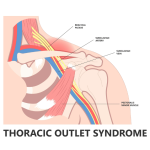
Thoracic Outlet Syndrome
June 24, 2025
Running Injuries
June 24, 2025
What does massive irreparable rotator cuff tear mean?
To understand what this means, we first need to understand what the rotator cuff is and how it works.
The anatomy of the shoulder
The shoulder is a ball and socket joint formed by the head of the humerus (arm bone) and the socket shaped glenoid in the shoulder blade. It is the most mobile joint in the body and has huge freedom of movement in lots different planes.
The glenoid is quite a shallow socket and if the shoulder didn’t have structures in place to keep the ball in the socket, it would easily come out of joint. Thankfully we have several structures which help to keep the ball centred in the socket when we move our arm. The main group of structures that help to do this is a sling of muscles and tendons called the rotator cuff. This sling of muscles comes from the shoulder blade and then attaches to the ball via structures called tendons.
The four main muscles of the rotator cuff are Supraspinatus, Infraspinatus, Subscapularis and Teres Minor. The Supraspinatus and Infraspinatus come from the back of the shoulder blade and attach onto the top and back of the ball. The Subscapularis comes from the front of the shoulder blade and attaches to the front of the ball. Teres Minor comes from the back of the shoulder blade and inserts on the lower part of the back of the ball. When we move our arm, particularly as we raise it up above the level of the shoulder, these four muscles contract and work together to keep the ball centred in the socket. This excellent system ensures smooth movement through the entire range.
What can go wrong with the rotator cuff?
The rotator cuff tendons – the structures that attach the muscles to the ball – often start to deteriorate as we get older. The tendons are made up of small fibres called collagen fibres. After around the age of 40-45, we can lose some of the stronger collagen fibres and this leaves the tendons more vulnerable to pain or injury. When we are in our 20s and 30s and we use the shoulder in a way that it is not accustomed e.g. heavier work or lifting more than usual or a new sporting activity, we usually don’t cause any pain or injury. However as we get older, because of the less strong collagen fibres, if we suddenly use our shoulder in a new and unusual way, this can cause damage or tears to the tendons. This doesn’t always cause pain but over time in some cases the damage can worsen and lead to complete tearing of the tendon or tendons. Similarly when we are in our 20s, if we fall and land on the shoulder, we are less likely to damage the tendons. However when we are older, the more fragile tendon tissue can more easily become torn from the direct impact of a fall.
Massive rotator cuff tears are defined as rotator cuff tears where there are more than two tendons torn and that one of those tendons is torn completely. In certain circumstances, these tears can be repaired by surgery. However, because these tendons tend to have quite advanced changes in the collagen, the tendons are often fragile and cannot be sutured successfully. In these cases, they are called massive irreparable rotator cuff tears.
What do patients experience when they have massive irreparable rotator cuff tears?
The surprising thing about this condition is that sometimes people with massive irreparable rotator cuff tears don’t even know that they have them. They have full range of motion of the shoulder and are able to do their normal everyday activities. This is because sometimes the other muscles and tendons are able to compensate and take over the role of the torn tendons.
However very often, patients with massive irreparable rotator cuff tears have significant pain and problems with their shoulder that impact quality of life. The patients that we see in clinic are usually unable to lift the arm above the level of the shoulder, have pain and weakness in the arm and are struggling with a range of activities such as reaching up, washing their hair, dressing, cooking or preparing food, gardening, lifting and carrying or playing sport or going to the gym.

Why do patients with massive irreparable rotator cuff tears often have difficulty lifting the arm past the level of the shoulder?
The rotator cuff tendons that insert on the ball of the shoulder all act in unison to keep the ball centred in the socket. The tendons at the front, back and top of the shoulder produce forces in different directions that oppose each other equally to create a balanced force couple. If one or more of these tendons is completely torn then this disrupts the balance of the forces and the ball can be moved out of the centre of the socket. From a practical point of view, what this often means is that when a person with a massive irreparable tear lifts their arm, the ball moves upwards and / or forwards and can press against the structures at the top of the socket thus blocking the smooth movement of the arm. The X-Ray below shows the ball abutting the top of the socket in a person with a massive irreparable rotator cuff tear.

How can physiotherapy help?
Physiotherapy exercises can help to strengthen and optimise the remaining muscles and tendons. Exercises also train the deltoid muscles to take over the role of the torn tendons. Eventually this can restore balance to the shoulder and centre the ball in the socket again. Ultimately this restores movement and function to the shoulder.
The ELEVATE programme
As part of his PhD project, EBTC co-founder and specialist shoulder physiotherapist, Eoin Ó Conaire has used the latest research and his own original published research to design a new physiotherapy programme for patients with Massive Irreparable Rotator Cuff Tear. This is called the ELEVATE programme. He is currently recruiting participants to a research trial to evaluate the programme. You can read more about that here. If you are eligible and accepted onto the research trial, treatment will be free-of-charge.


