Painful, numb legs when kayaking: Part 2: Exercises
September 24, 2025The Surprising Power of 20 Minutes a day. What I discovered after 3 years of daily meditation
September 25, 2025I have a unique personal attachment to this common condition in kayakers. I am currently a chartered physiotherapist specialising in musculoskeletal problems and sports injuries and a keen paddler of K1 racing boats. However, several years before I even started my training as a physiotherapist I used to suffer terribly from numb painful legs when I went canoeing. At the time I was about 15 or 16 and had just started to do a few marathon ranking races in Ireland. I got occasional numb legs in most boats that I paddled but the problem really started in earnest when I started paddling a Gola Sprint. This was about 1988 or 1989 and the Gola sprint was taking the General purpose racing class by storm. For those not familiar with it, it was basically a K1 style general purpose boat. It looked like a wildwater racer kayak that had been on a diet. Crucially it satisfied the criteria for the GP class. Basically if you could stay upright in it, you could win races!
It was an absolute flyer but very tippy and I found that I got terrible cramps, pain, pins and needles and dead legs after only about 5 mins paddling. I tried to ignore it and push on through but the pain became agonising and I would either capsize or struggle to get out and feel my legs collapsing under me with pins and needles and numbness. I was advised to raise the seat with a few seat-pads but this made no difference other than to make me a bit more unstable! I was advised to stretch my hamstrings – no difference. It got to the stage where I just couldn’t paddle the boat and reluctantly sold it.
I drifted away from canoeing for many years and then in my mid-thirties (now an experienced UK-based physiotherapist) I took up paddling again – joining the fantastic Elmbridge canoe club on the Thames in Surrey where you have no option really but to race! It was great fun getting back into paddling but once again even in K1 boats, I started to get those numb cramps in my calves, hamstrings and even up into my hips – especially as I started upgrading to faster more unstable boats and paddling longer distances.
However now with all my new knowledge of anatomy, biomechanics and neuromusculoskeletal conditions, I had a fair idea what was causing the problem and set about sorting it out so that I could get maximal enjoyment out of my paddling.
I have always had tight hamstrings (after years of football and running) but tight hamstrings don’t directly cause pins and needles and numbness. These sensations are associated more with nerves or occasionally blood vessels (circulation). The position that we sit in a kayak (particularly if you are a bit slumped) is very similar to one of the tests for sensitivity of the sciatic nerve. The sciatic nerve and its main divisions basically run from the nerve roots in the low lumbar spine deep into the gluteal muscles along the outside hamstrings, down the calf muscles, behind the ankle and into the sole of the foot. Therefore when we sit slumped in a kayak with our feet up against the foot-rest we are tensioning the sciatic nerves in each leg. Continuous tensioning of the nerve can cause irritation and nerve pain anywhere along the course of the nerve. In addition if there is compression of the nerve anywhere along its course then this pressure on the nerve can bring about the symptoms of nerve pain.
I am in no way comparing myself to the great Tim Brabants but the picture below shows by means of a drawn-on red line where the sciatic nerve and its divisions travel along the legs and how the paddling position could cause tension.
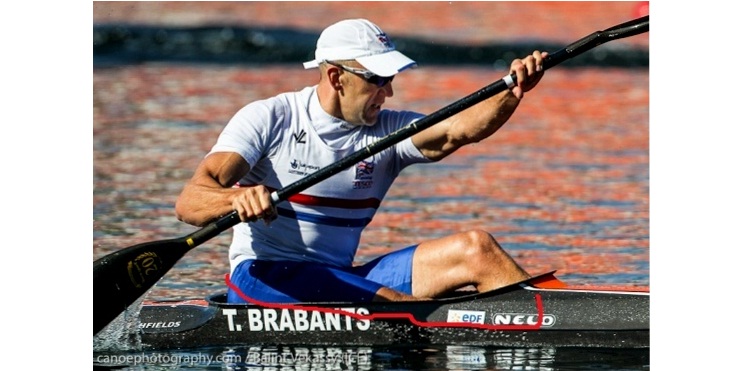
I deduced that my problem was as follows:
- Very tight gluteal, hamstring and calf muscles pulling me down into a slumped position and tensioning the sciatic nerves in both legs.
- Long term nerve tightness in the sciatic nerves and its branches
- When I paddled less stable boats I didn’t have enough “leg drive” i.e. not pushing hard enough with the opposite foot as I rotated my trunk and pulled the paddle through the water – causing increased tension in the leg muscles
I therefore set about systematically addressing these problems. I carried out a series of nerve gliding / tension exercises to improve the mobility of the sciatic nerves. Alongside these I worked on my hamstring, gluteal and calf length with a series of exercises. I found yoga-style poses the most effective for this. This is because when you have tight muscles your body will subtly try to cheat and avoid stretching the tight muscles. The yoga poses generally aim to stretch a series of tight muscles rather than isolating one. I also worked on my core stability and in particular with my new-found hamstring length, my ability to sit in a neutral spinal posture (i.e. not slumped) in my boat. Finally I paid extra attention to the leg-drive element of my paddling technique.
Within 6 weeks I was completely cured and just have to do a few stretches every so often to stop it tightening up.
I hope this blog helps a few kayakers as I think that if I had known all of this years ago, I may not have drifted away from canoeing for so long.